
|
|
|
|
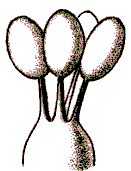
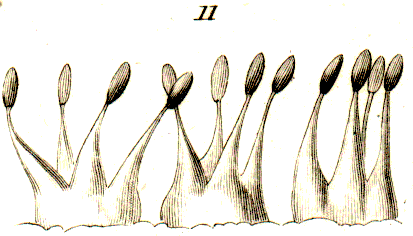
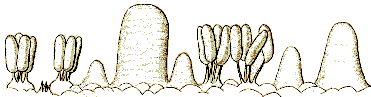
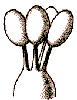
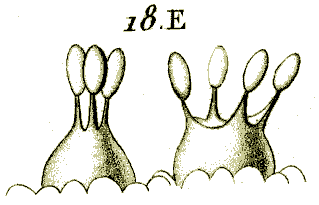 As John Ramsbottom (1953) has pointed out, several other mycologists made the same discovery at about the same time, and "it is of little consequence to assign priority." (p. 23) However, Léveillé was clearly more effective in the presentation of his discovery. For one thing, he had been working on it for a long time, and was able to provide illustrations many different kinds of basidia and spores in boletes, gilled mushrooms, and club fungi. He also was able to show the importance of basidia for purposes of taxonomy, and proposed the conceptual split, which we still keep, between ascomycetes and basidiomycetes.
|
|
 His Memoire sur le genre Sclerotium, while less earth-shattering, showed that the "organisms" placed in the genus Sclerotium had a fungal structure and were probably part of the mushrooms growing out of them (rather than a separate organism). This was an essential first step in clearing out genera that had been created for parts of fungi, such as Rhizomorpha, Byssus, and Ozonium. Byssus was a genus for white mycelium, and Ozonium a genus for colored mycelium, such as that of Coprinus radians.
|
|
 He studied medicine in Paris and received his MD in 1824.
In this article, Léveillé coined the terms basidium and cystidium, and proposed the modification of Fries' system of classification: division of the fleshy fungi into what are now the phyla Basidiomycotina and Ascomycotina, and the further division of Basidiomycotina into the Hymenomycetes and Gasteromycetes.
This is an unusual Flora in that its subject is not a place or a taxonomic group, but a previous author's field guide, that of Paulet.
 Glossary |  Mushrooms |  |  People |  Newsletter |  Events |